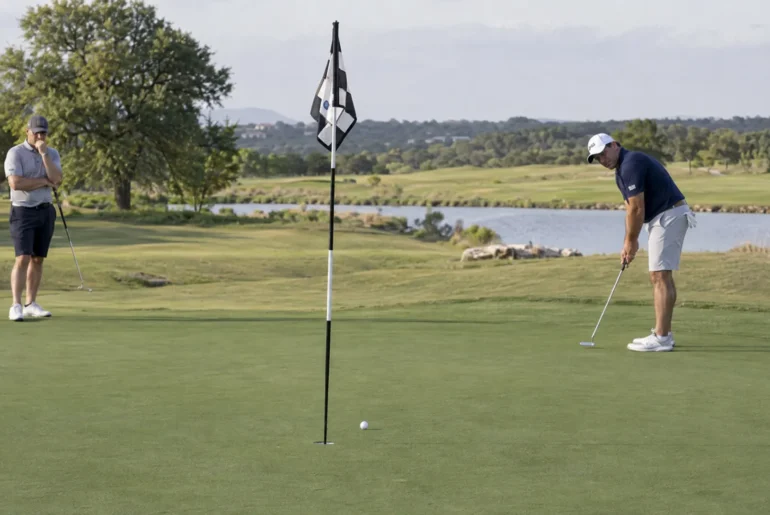
The best purchase at a golf equipment store is not necessarily the club that produces your longest shot. It is the equipment that improves your typical results, fits your body and works where you actually play or practice. Before buying, test consistency, comfort and suitability rather than relying on a handful of impressive swings.
A useful store visit should answer three questions: Does this outperform what you own? Can you repeat the result? What happens if it does not work outside the demo area?
Bring a Baseline Before You Start Testing
Bring your current club in the category you want to replace. Without it, you are comparing new equipment against your memory, which tends to emphasize your best shots rather than your normal performance.
Also bring your golf shoes, glove and, if permitted, the ball model you normally play. Ball choice can affect launch, spin and feel, so switching balls during a comparison makes the results harder to interpret.
Decide what problem you want to solve before visiting a golf equipment store. A driver that reduces your right miss requires a different evaluation from one intended to increase carry distance. Likewise, an iron replacement should address a specific need, such as better contact or more reliable distance gaps.
Note your budget, including potential fitting charges, shaft upgrades and adjustments. Ask whether any fitting fee applies toward a purchase rather than assuming it does.
Agree on a Fair Test Procedure
Warm up before recording results. Then hit a short block with your current club, followed by a similar block with each candidate. Return to your current club near the end to check whether warming up or fatigue changed your swing.
Five to eight shots per block can help screen options, but that is not enough to establish a definitive fit. Promising combinations deserve additional testing, especially if your strike varies considerably.
Keep legitimate mishits in the comparison. A club's performance on imperfect contact matters because those shots happen on the course. Exclude only obvious tracking failures or interrupted swings, using the same rule for every club.
Ask staff to keep the simulator's environmental settings consistent, including wind, altitude and ground firmness. Compare actual club-and-shaft combinations you could buy, not a demo setup unavailable in your specification.
What to Measure at a Golf Equipment Store
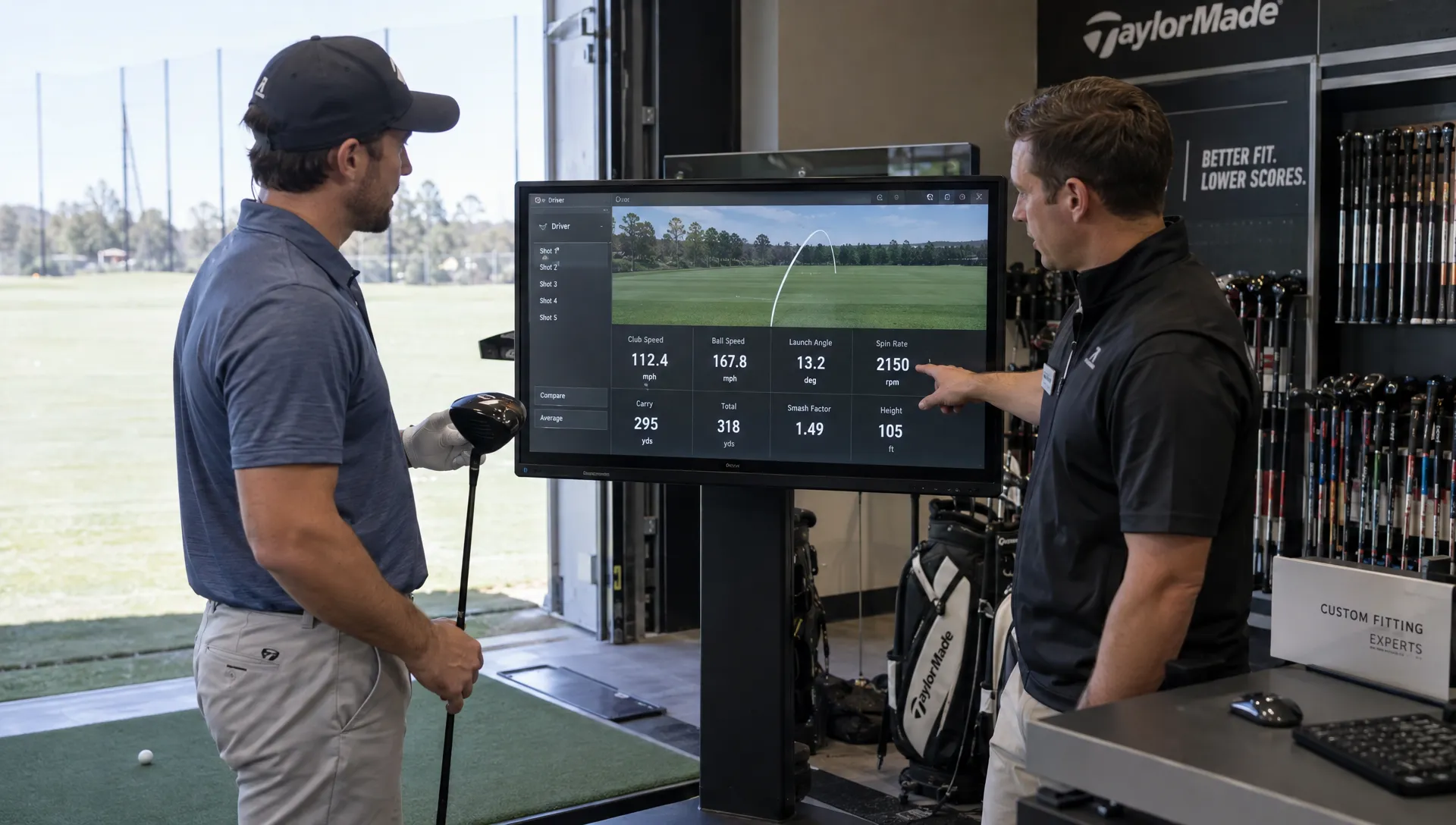
A launch monitor can make comparisons more useful, but one impressive number should not decide the purchase. Start with these measurements:
| Measurement | What it helps you evaluate | What to watch for |
|---|---|---|
| Carry distance | How far the ball travels before landing | Compare typical shots, not only the longest |
| Left-to-right dispersion | Directional consistency | A longer club may also produce a wider miss pattern |
| Front-to-back dispersion | Distance control | Useful when deciding whether irons hold predictable yardages |
| Impact location | Strike consistency | Ask about suitable impact spray or tape |
| Launch and spin | Flight characteristics | Interpret together with speed, strike and the club's purpose |
| Landing angle | How steeply the ball arrives | Particularly relevant for approach clubs |
Carry distance is usually more useful than simulated total distance for comparing approach clubs. Total distance depends heavily on bounce and roll, which may be modeled rather than observed indoors.
Ask which measurements the launch monitor captures directly and which it calculates. Some systems do not measure every displayed parameter. Save the results or request a fitting summary so you can review the comparison without sales-floor pressure.
Driver: Test Your Normal Miss, Not Just Your Best Swing
Hit your driver at normal playing effort. Swinging unusually hard to chase a distance record tells you little about whether the new club will help on a narrow tee shot.
Compare carry distance, impact location and the width of your shot pattern. Check whether heel and toe strikes remain reasonably playable. A slightly shorter average drive may be a better purchase if it meaningfully reduces severe misses.
When testing a driver at a golf equipment store, ask to compare suitable loft, shaft weight and playing-length options rather than choosing by flex label alone. Flex labels are not standardized across all shaft models, and the complete build affects how the club feels and performs.
There is no universal launch-and-spin target for every golfer. Ask the fitter to explain the recommendation using your swing speed, delivery and strike pattern. Record adjustable settings so the club you receive matches the tested configuration.
Irons: Check Distance Gaps and Stopping Ability
Do not compare irons solely by the number stamped on the sole. Two 7-irons can have different lofts and lengths, so extra distance does not automatically indicate a better fit.
Start with a mid-iron, then test a longer iron and a short iron if demo availability allows. Look for predictable carry, consistent contact and a flight that suits your approach shots. Check whether the longer club launches high enough to remain useful rather than simply traveling farther on low, rolling shots.
At a golf equipment store, an iron comparison should include the transition into your existing wedges and hybrids. A new set can create an awkward gap at either end even when the mid-iron performs well.
Ask how length and lie angle were assessed. Lie-board marks alone should not be the entire diagnosis; ball flight and dynamic measurements provide additional context. Confirm whether recommended adjustments are included in the quoted price.
Fairway Woods and Hybrids: Test From the Ground
If you primarily need a club for fairway shots, do not evaluate it only from a tee. Test from the hitting surface and use a tee only when that matches its intended role.
Compare strike reliability and usable carry against the club immediately above and below it in your bag. A hybrid that travels almost the same distance as your longest iron may not solve your gapping problem.
Be cautious about turf interaction on a forgiving indoor mat. The surface can disguise contact that would lose more speed from grass. If possible, arrange an outdoor demo before replacing a club you depend on for long approaches.
Wedges: Separate Full-Swing Results From Short-Game Fit
Hit full swings and partial swings, then try chips and pitches if the facility allows them. Check whether the head feels manageable on short shots rather than judging it only by full-swing distance.
Wedge bounce and sole grind influence turf interaction, but a firm mat cannot reproduce every grass or bunker condition. A golf equipment store can help narrow wedge specifications; testing from turf and sand is the better way to confirm them.
Explain your usual conditions to the fitter, including firm or soft fairways, bunker sand and whether you tend to take deep divots. For used wedges, inspect the face and grooves for wear. A clean-looking head does not necessarily have a lightly used hitting surface.
Test Putters for Start Line and Distance Control
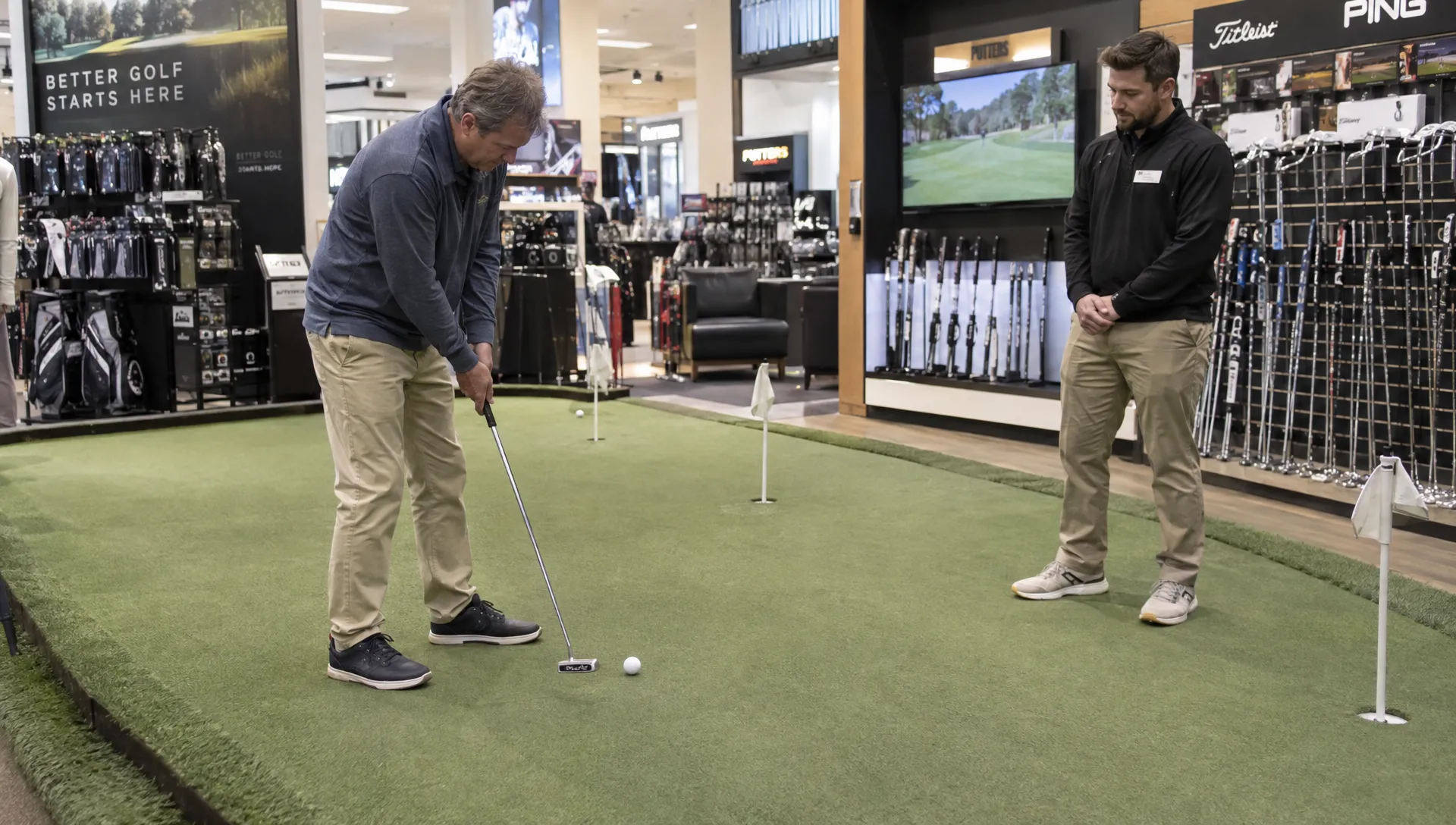
Begin with straight short putts to check alignment and start direction. Then move farther away to evaluate pace. A putter that feels stable from a few feet still needs to help you control longer putts.
Use several attempts from each distance rather than judging one make or miss. Where permitted, a simple start-line gate can help distinguish directional control from fortunate breaks on the practice surface.
Check whether the length allows a comfortable posture without crowding your body or forcing you to reach. Notice grip pressure, face awareness and whether the head's weight makes distance control easier or harder.
The putting surface matters too. Results on a smooth store green may not transfer directly to slower or bumpier course conditions. When comparing putters at a golf equipment store, prioritize repeatable aim and pace over how many balls happen to drop into one practice cup.
Check Shoes, Gloves and Grips Under Playing Conditions
Try shoes with the socks you wear on the course and test both feet. Walk, turn and adopt your golf stance. Your heel should feel secure without painful pressure, while your toes need room rather than being pressed against the front.
A store floor cannot reproduce wet-grass traction, so separate fit testing from claims about on-course grip. Ask about the policy for footwear that has been worn outdoors.
For gloves, check finger length and palm fit while holding a club. For grips, try samples of different sizes and textures. Choose a size that supports comfortable hand placement and grip pressure, not simply the thickest option available.
Test Practice Equipment Beyond Its Product Label
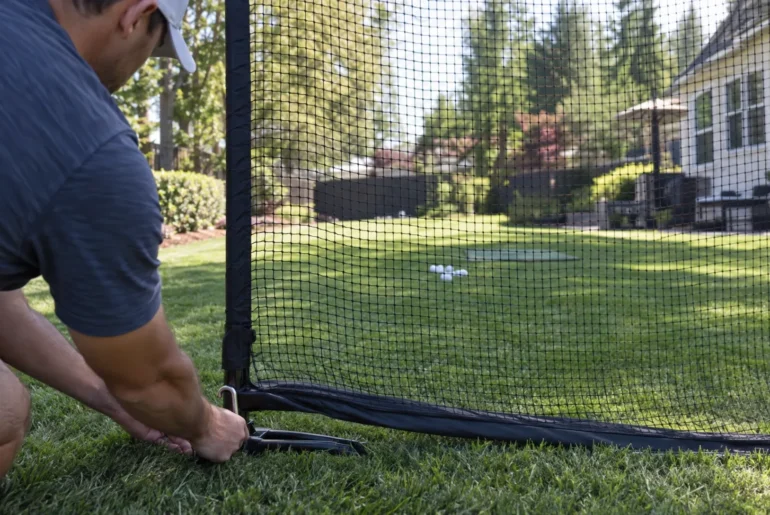
Home practice gear deserves the same scrutiny as clubs. Measure your available space before shopping, accounting for the swing arc, ceiling height and manufacturer-required clearances.
For hitting mats, inspect stability, cushioning and the hitting area's dimensions. If a designated demo area is available, ask permission to make a few controlled swings. Notice whether the mat slides or produces uncomfortable impact feedback. Do not repeatedly hit down on a surface that causes pain.
Thrill Golf's guide to choosing a golf hitting mat for a garage can help you narrow the setup requirements before comparing samples.
When evaluating practice gear at a golf equipment store, ask about the exact model's intended use rather than assuming every net or mat handles full-speed shots.
For nets, inspect seams, attachment points and frame stability. Check the manufacturer's ball-speed or club-use guidance, required hitting distance and installation instructions. Never assume a display net is approved for live shots.
For putting surfaces, look for flatness, consistent roll and storage requirements. Our guide to indoor putting greens for home covers options to compare with your available space and practice goals.
Verify the Exact Item and Purchase Terms
Before paying, confirm that the equipment matches what you tested. For clubs, record the model, loft, shaft model and weight, flex, playing length, grip and any adjustable settings. A different shaft or length means you are no longer buying the same tested combination.
For used clubs, check the shaft, ferrule, grip and head for visible damage or unusual repairs. Cosmetic scratches and structural concerns are different issues, so ask staff to explain anything questionable. If competition legality matters, consult the USGA equipment standards resources rather than relying on appearance alone.
A golf equipment store's purchase terms can matter as much as the demo results. Ask whether hitting the club changes return eligibility, whether custom orders are final sale and whether any trial arrangement provides a refund or only store credit.
Get relevant promises in writing, including delivery specifications, adjustment costs and warranty procedures. Do not assume a manufacturer's warranty covers accidental damage, normal wear or every component of a used club.
Buy the repeatable improvement, not the single best shot. If the evidence is unclear, save the specifications and arrange another test instead of forcing a decision that day.
Frequently Asked Questions
Should I get fitted before buying clubs? A fitting is useful when you need help choosing length, loft, lie angle or a shaft combination. Its value comes from comparing suitable options against your current equipment, not simply assigning a flex label.
Can simulator numbers be misleading? Yes. Changed environmental settings, different balls, tracking errors and selectively removing mishits can distort comparisons. Keep conditions consistent and ask how the displayed measurements are obtained.
How many clubs should I test at a golf equipment store? Begin with a small shortlist that addresses your specific problem. Testing too many combinations can introduce fatigue and make comparisons less reliable. Revisit the strongest candidates after checking your baseline again.
Is an indoor test enough for wedges? It can help assess specifications, contact and feel, but it does not fully establish turf or bunker performance. An outdoor demo is preferable when choosing bounce and sole grind.
Build Your Shortlist Before You Shop
Use Thrill Golf's equipment comparisons and practice guides to identify what you need before visiting a store. Bring your baseline club, keep the test conditions consistent and leave with documented specifications. Those steps make it easier to distinguish a useful upgrade from an appealing demo.