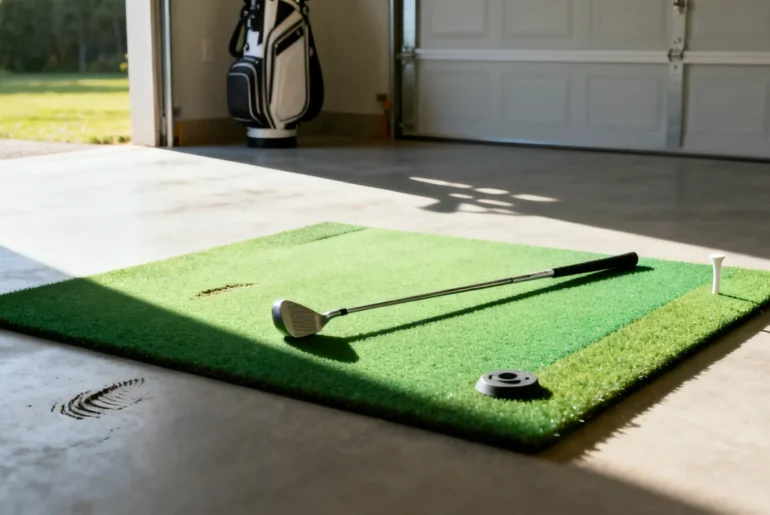

The best golf hitting mat for garage use combines realistic turf feel, joint-protecting impact absorption, and a stable base that won't slide on concrete. Choose a mat with a replaceable hitting strip and dimensions that fit your swing arc without crowding walls or ceiling. The right mat turns your garage into a year-round practice facility, helping you work on ball-striking mechanics at home without driving to a range. Golfers who build a proper setup can practice daily, rain or shine, while keeping their wrists and elbows comfortable from one session to the next.
A quality mat also pairs well with a home golf simulator or a compact practice net, opening up the kind of repeatable feedback loop that used to require a club membership. Sizing matters, and so does construction, which is why this guide walks through the features that separate a true garage mat from a backyard or commercial range option.
Table of Contents
- What Makes a Golf Hitting Mat 'Garage-Ready'?
- Garage Golf Mats vs. Range Mats: Key Differences
- How a Quality Hitting Mat Protects Your Game and Joints
- Setting Up Your Garage Hitting Station Step by Step
- Side-by-Side: Comparing the Best Golf Hitting Mats for Garage Simulators
- Mistakes That Ruin a Perfectly Good Garage Setup
- Is a Garage Hitting Mat Right for Your Practice Goals?
- Why We Stock the Mats We Do at Thrill Golf
- Frequently Asked Questions About Garage Golf Hitting Mats
What Makes a Golf Hitting Mat 'Garage-Ready'?
Not every hitting mat belongs in a garage. The concrete floor changes everything. A mat that feels fine on a range turf can feel dead on concrete. The best golf hitting mats for home use share a few common traits.
Key Features of the Best Golf Hitting Mat for Garage
-
Impact absorption. A garage mat needs enough padding to protect your wrists and elbows from jarring strikes. Thickness alone is not the whole story, because the construction layers matter more. A rubber base, a mid-layer of foam or fiber, and a synthetic turf face that gives slightly under the club work together to soften every strike.
-
Stability. The mat must stay put during a full swing. Look for a non-slip rubber bottom, or a mat heavy enough not to slide on smooth flooring. Some mats come with rubber underlayment built in. Others work best when you add a separate pad underneath.
-
Size. A standard 3×5 ft mat works for most garages. It gives you room to stand comfortably and hit from the center. If you plan to install a full simulator, a 5×5 ft mat offers more lateral space for stance and swing path.
How Thick Should Your Garage Mat Be?
Thickness varies by construction. Fiber-based mats like the Fiberbuilt Player Preferred Golf Mat can be thinner because the fiber layer absorbs shock through vertical compression. Foam-core mats need more depth, often 1.5 to 2 inches, to achieve the same protection. The goal is to replicate the feel of a well-maintained fairway lie without transferring impact energy to your body.
What Surface Feel Should You Expect?
A good garage mat should feel firm but forgiving. The ball should sit up naturally, and the club should glide through the hitting area without bouncing. Mats with too hard a surface launch the ball high and make fat shots feel worse than they are. Softer mats simulate a perfect lie every time, which is fine for swing work but less useful for turf interaction practice.
Garage Golf Mats vs. Range Mats: Key Differences
Many golfers make the mistake of buying a commercial range mat for home use. These mats are built to survive thousands of shots from strangers, not to protect your joints. The design goals are different.
Why Garage Mats Prioritize Joint Protection
Range mats are thick and dense. They absorb impact but transfer shock straight up the shaft. A garage mat designed for home use relies on layered construction (a rubber base, foam or fiber core, and soft turf top) to diffuse impact. The USGA publishes home practice guidance that includes safety clearances for indoor setups, and the recommendations emphasize room for a full swing and a stable, non-slip hitting surface.
Can You Use an Outdoor Mat in the Garage?
Outdoor hitting mats often lack the rubber bottom needed to stay flat on concrete. They are made for grass or dirt, not a smooth garage floor. The turf face is usually coarser to handle wear from dirt and debris. Using one indoors means you lose stability and feel. The best golf hitting mats for home use are explicitly designed for indoor or simulator use.
Here is a quick comparison:
| Mat Type | Joint Protection | Stability on Concrete | Surface Feel |
|---|---|---|---|
| Garage/Simulator Mat | High (layered construction) | Excellent (non-slip rubber base) | Soft, forgiving |
| Outdoor Practice Mat | Medium (dense foam) | Poor (slides on smooth floors) | Firm, durable |
| Commercial Range Mat | Low (single-layer rubber) | Good (heavy but hard) | Hard, high bounce |
How a Quality Hitting Mat Protects Your Game and Joints
The physics of a golf swing involve moving a steel or carbon fiber club head at speeds approaching 100 mph into a stationary object. That energy has to go somewhere. A quality hitting mat absorbs and redirects it.
What Impact Absorption Really Means
When a club strikes a good mat, the turf face compresses, the mid-layer absorbs the blow, and the rubber base dampens the vibration. The result is a smooth feel through the ball. Poor mats launch the club head back at you, sending shock waves into your hands, wrists, and elbows. Repetitive shock loading is well documented in sports medicine as a contributor to overuse injuries in the lead wrist and lead elbow, which is why mat construction matters far more for daily home practice than it does for an occasional range visit.
Replaceable Hitting Strips Save Money Over Time
Golfers who practice daily wear out the hitting area quickly. A mat with a replaceable hitting strip lets you swap the worn section instead of buying a whole new mat. The Fiberbuilt Player Preferred Golf Mat includes a fiber-based hitting strip that is replaceable. The SIGPRO Softy Golf Mat is another option known for its soft feel. Both are popular choices among home simulator builders.
What Makes Fiberbuilt and SIGPRO Stand Out?
Fiberbuilt uses a fiber technology that stands the turf strands vertically. This creates a consistent hitting surface that does not compact over time. SIGPRO uses a foam and rubber sandwich that many golfers describe as realistic. Neither mat is cheap, but both are built for daily full-swing practice in a garage environment. Reddit communities frequently cite these mats when discussing the best golf hitting mat for garage setups.
Setting Up Your Garage Hitting Station Step by Step
Setting up a garage hitting station requires more than just unrolling a mat. Follow these steps in order for a safe, effective practice area.
-
Measure your space. The USGA recommends generous ceiling height for a full swing with a driver, and Trackman publishes room-dimension guidelines for simulator setups. Make sure your garage ceiling is at least nine feet for typical swing arcs, and ten feet if you want full driver clearance.
-
Choose the mat size. For a garage with limited space, a 3×5 ft mat works. For a dedicated simulator bay, a 5×5 ft mat gives more room. Carl's Place offers enclosure planning resources that help match mat size to your work space. Also check our guide to the best golf practice net for a small yard if you plan to combine mat and net.
-
Lay underlayment on the concrete. Anti-fatigue mats or rubber floor tiles prevent the mat from sliding and add an extra layer of shock absorption. Skipping this step leads to mat movement mid-swing and a dull feel through impact.
-
Position the mat so the hitting strip aligns with the center of your swing arc. Stand on the mat and take a practice swing. Adjust until the divot spot lands on the middle of the hitting area.
-
Test slow swings first. Hit ten half swings to confirm the mat does not shift. If it moves, add more underlayment or a heavier mat. Then start full practice.
Side-by-Side: Comparing the Best Golf Hitting Mats for Garage Simulators
This table compares five popular hitting mats. All are known in the golf community and mentioned frequently on Reddit and home simulator forums.
| Mat Name | Best For | Surface Feel | Replaceable Hitting Strip | Ideal Garage Use Case |
|---|---|---|---|---|
| Fiberbuilt Player Preferred Golf Mat | Realistic feel and shock absorption | Soft, forgiving fiber weave | Yes | Daily full-swing practice with a simulator |
| Country Club Elite Golf Mat | Traditional mat feel, durability | Firm but consistent | No (single-piece) | Repetitive full-swing practice in a net |
| BirdieBall Premium Turf Hitting Mat | Fairway-style turf simulation | Soft, with realistic ball lie | No (single-piece) | Mixed practice (irons and driver) |
| Carl's HotShot Golf Mat | Modular system with replaceable strips | Moderate, customizable | Yes (modular strips) | Budget-friendly garage setup |
| SIGPRO Softy Golf Mat | Forgiving strike sensation | Soft, low impact shock | Yes (replaceable strip) | Joint-friendly practice for seniors or injury recovery |
Reddit communities such as r/golf and r/homegolf frequently discuss these mats. The Fiberbuilt Player Preferred Golf Mat is a top result when searching for "best golf hitting mat for garage reddit." Real-world user feedback validates that these are the options worth comparing.
Fiberbuilt vs. Country Club Elite: Which Is the Best Golf Hitting Mat for Garage?
Fiberbuilt wins on joint protection and customization. The hitting strip design lets you practice off a consistent, soft surface. Country Club Elite wins on simplicity and a lower price point. It is a one-piece mat that handles full swings well, but it lacks the replaceable strip feature. For most garage users, Fiberbuilt offers a better long-term value.
What About BirdieBall, Carl's HotShot, and SIGPRO?
BirdieBall offers a more turf-like experience. Carl's HotShot gives you a modular system with replaceable hitting strips, which is great for budget-minded golfers. SIGPRO Softy is the go-to for golfers who need maximum shock absorption, especially those with prior wrist or elbow issues. All three are valid options depending on your budget and practice goals.
Mistakes That Ruin a Perfectly Good Garage Setup
The most common mistake is buying a mat sized for a range bay and discovering it crowds the garage so badly that the backswing clips a wall or shelf. The fix is to measure ceiling height and lateral clearance before purchasing, not after. A 5×5 ft mat that arrives at a 4×4 ft space becomes either a return shipment or a permanent compromise, and either outcome is avoidable with a tape measure.
A subtler trap is skipping underlayment on bare concrete. The mat slides mid-swing, the strike feels dead, and the golfer often blames the mat when the real culprit is the hard surface underneath. Rubber tiles or a dedicated anti-fatigue layer solve both problems for less than the cost of replacing the mat itself.
The most expensive failure is treating the hitting strip as permanent. Golfers who pound the same spot daily wear through the turf face within weeks and then replace the entire mat instead of choosing one with a replaceable hitting strip insert. The math is simple. A single strip costs a fraction of a full mat, and replacing it takes minutes rather than days of shipping wait.
Outdoor mats marketed for backyard use are a related category mistake. They are thinner, often coarser on the turf face, and lack the rubber base needed to stay flat on a garage floor. They serve a different use case. Overlooking ceiling height is another quiet killer. A low garage ceiling forces a flat swing plane, which trains a habit you do not want carried to the course. If your ceiling is under nine feet, consider sticking to irons in the garage and saving driver work for a range visit.
Is a Garage Hitting Mat Right for Your Practice Goals?
Not every golfer needs a garage mat. It is best for players who want to work on ball-striking mechanics, tempo, and contact quality between range sessions. It pairs well with a launch monitor or simulator for instant feedback.
When Does a Garage Mat Make Sense?
If you live in a climate where outdoor practice is seasonal, a garage mat keeps you swinging all year. It is also ideal for golfers who want to practice late at night or early in the morning without driving to a range. For players tracking their progress, pairing a mat with tools like our guide to the best free golf GPS apps helps measure improvement on the course as well.
What Practice Activities Work Best on a Mat?
Full swings with irons and driver work great on a quality mat. Chipping and pitching are less useful because the mat does not simulate real turf. For short game, you are better off with a dedicated chipping mat or a sand wedge on a course. If putting is a bigger part of your home practice plan, our indoor putting green guide for home covers the gear worth considering alongside a hitting mat.
Can a Garage Mat Widen Your Skill Set?
Yes, with the right drills. You can work on swing plane, tempo, and contact with immediate feedback from a mat. Many golfers find that a golf simulator combined with a good mat provides data they never get at a range, which can accelerate improvement faster than range sessions alone.
Why We Stock the Mats We Do at Thrill Golf
At Thrill Golf, we look for golf training aids and accessories that deliver real value without breaking the bank. We stock the Fiberbuilt Player Preferred, Country Club Elite, and other proven mats because they have track records with our customers. We are passionate about great bargains and excellent service, and our team tests the gear we sell.
We know that buying a hitting mat is an investment. That is why we focus on budget-friendly products that do not compromise quality. Whether you need a full simulator mat or a compact 3×5 foot mat for a tight garage, we have options that fit your space and your budget. Our friendly support team can help you find the right mat for your garage setup, and satisfied customers all over the world trust us for their golf practice needs. Feel free to browse our selection or contact us for a personalized recommendation.
Frequently Asked Questions About Garage Golf Hitting Mats
What Is the Best Flooring for a Garage Golf Simulator?
Rubber underlayment or interlocking foam tiles over concrete are the standard recommendation. Both add shock absorption and prevent the mat from sliding during a full swing. Industry resources from Carl's Place and Trackman cover room layout in detail, and the basic rule of thumb is to cover the full footprint of the hitting and standing area, not only the strike zone itself.
How Thick Should a Golf Hitting Mat Be for a Garage?
Thickness depends on construction. Fiber-based mats like the Fiberbuilt Player Preferred can be thinner because the fiber layer absorbs impact through vertical compression. Foam-core mats need 1.5 to 2 inches of depth to achieve the same joint protection. If you are unsure, add a rubber underlayment instead of buying a thicker mat outright.
Can I Use an Outdoor Golf Mat in My Garage?
Generally no. Outdoor mats are designed for grass or dirt, so they often lack the non-slip rubber base needed for hard flooring. The turf face is also coarser to handle dirt and weather, which makes the feel less realistic during indoor practice. A mat marketed specifically for indoor or simulator use is the better choice for a garage.
Do I Need a Hitting Strip on My Garage Mat?
A replaceable hitting strip is strongly recommended for daily practice. It localizes wear to a swappable insert rather than the entire mat surface, which saves you from replacing the full mat every few months. If you practice fewer than a couple of sessions a week, a one-piece mat may last long enough to be a fine alternative.