
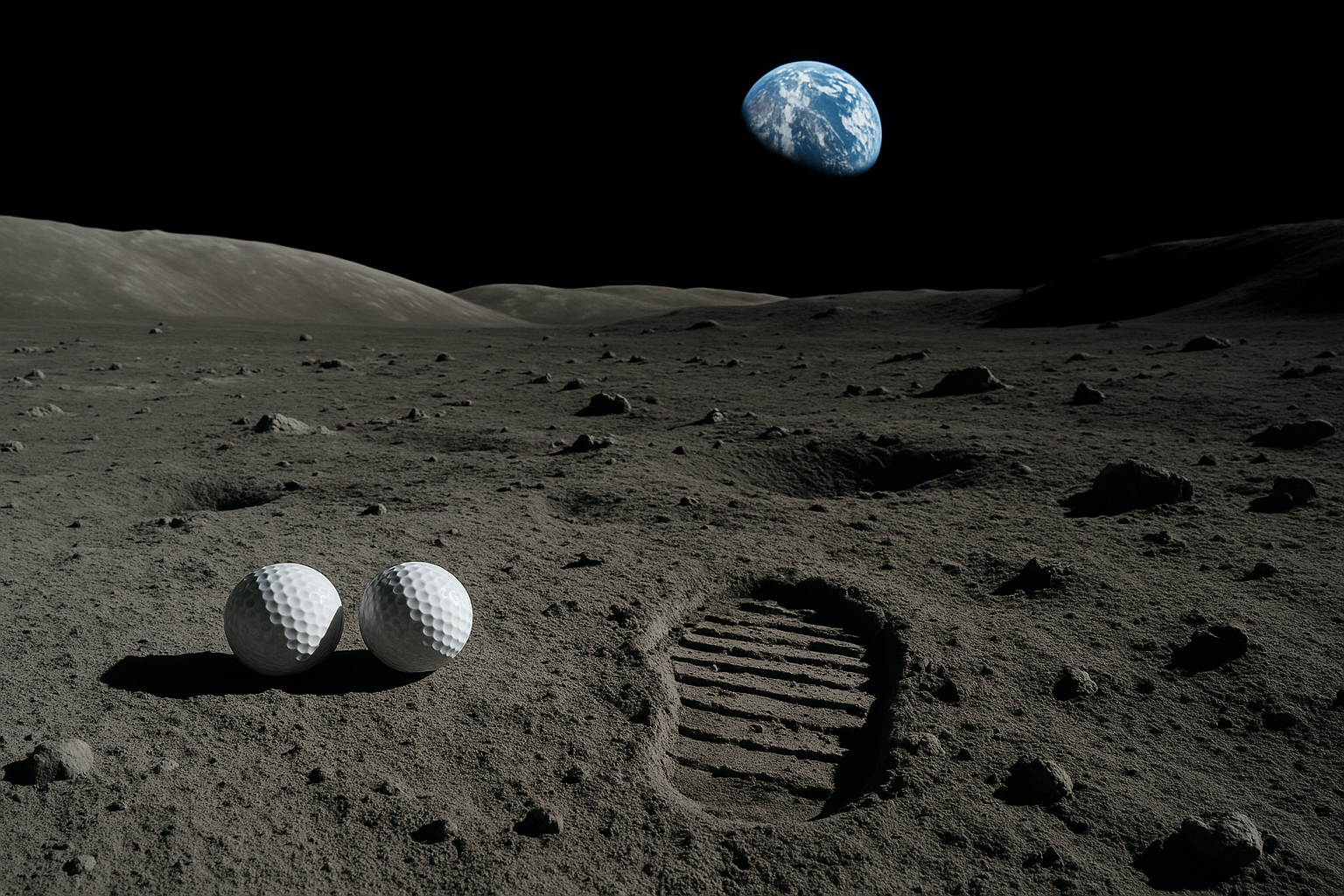
Two golf balls are on the moon. Both were struck by astronaut Alan Shepard during the Apollo 14 mission on February 6, 1971. They remain exactly where they landed on the Fra Mauro highlands, preserved in the lunar environment where there is no wind, water or weathering to disturb them.
This simple answer concludes one of golf’s most unusual trivia questions, but the full story reveals careful planning, improvised equipment, and a moment that captured the imagination of millions watching from Earth.
The Complete Story of Lunar Golf: Apollo 14 Mission
Alan Shepard, commander of Apollo 14 and America’s first astronaut in space, brought golf to the moon as an unofficial experiment in his personal preference kit, a small allowance of personal items each astronaut could carry. He did not announce the plan to NASA leadership beforehand, concerned they might reject it as frivolous.
Shepard worked with Jack Harden, the club pro at River Oaks Country Club in Houston, to design a makeshift club head that could attach to a lunar sample collection tool. The six-iron head was built to snap onto the handle astronauts used for gathering rock samples. He smuggled it aboard in a sock.
After completing all assigned mission objectives on the lunar surface, Shepard attached the club head, dropped two golf balls, and attempted his shots while wearing a bulky pressure suit that severely restricted his swing. The suit allowed only a one-handed motion, making proper golf mechanics impossible.
What Happened to Each Shot
Shepard’s swing limitations meant the first shot was less than impressive:
- First ball: Shanked into a nearby crater. Shepard described it as going only about 40 yards.
- Second ball: Made better contact. Shepard famously claimed it went “miles and miles and miles,” though physicists later estimated the actual distance at 200 to 400 yards.
The reduced lunar gravity (one-sixth of Earth’s) and lack of atmospheric resistance would theoretically allow a golf ball to travel significantly farther than on Earth. A well-struck drive could travel up to six times the Earth distance. However, Shepard’s restricted swing prevented him from generating normal clubhead speed, which limited the advantage gravity provided.
The Physics Behind Lunar Golf Ball Flight
Several factors make lunar golf fundamentally different from the game on Earth:
| Factor | Earth | Moon |
|---|---|---|
| Gravity | 9.8 m/s² | 1.62 m/s² |
| Atmosphere | Present (creates drag) | None (vacuum) |
| Typical drive distance | 200–250 yards | 1,200–1,500 yards (theoretical) |
| Ball flight time | 5–7 seconds | 30–40 seconds |
Without air resistance, a golf ball on the moon follows a perfect parabolic trajectory determined only by initial velocity and angle. Spin has no effect because there is no air for the ball to grip. The ball travels in a vacuum until it contacts the surface.
Shepard’s one-handed swing while wearing a pressure suit meant he could not generate anywhere near the 100+ mph clubhead speed a normal golfer produces. Estimates suggest he achieved roughly 25–30 mph, which explains why his best shot traveled only a few hundred yards rather than the theoretical maximum.
What Happened to the Improvised Six-Iron
After hitting both balls, Shepard left the club head attached to the sample tool handle on the lunar surface. NASA mission protocols required astronauts to leave non-essential items behind to reduce weight for the return journey. The makeshift club remains on the moon alongside the two golf balls, the sample collection tools, scientific equipment, and the lower stage of the lunar module.
The club Shepard used was never a complete golf club. Only the six-iron head made the trip, specifically modified to attach to existing lunar equipment. The standard aluminum handle of the sample collection tool served as the shaft.
Are the Golf Balls Still There Today
Yes. The lunar environment ensures near-perfect preservation. With no atmosphere, there is no wind erosion, no rain, no oxidation, and no biological decay. The moon’s surface changes extremely slowly, affected only by micrometeorite impacts and the gradual effects of solar radiation.
The golf balls have experienced temperature extremes ranging from -173°C during lunar night to +127°C in direct sunlight, but the vacuum environment prevents thermal degradation. The balls will remain in nearly pristine condition for millions of years unless directly struck by a meteorite or disturbed by future lunar visitors.
In 2011, imaging specialist Andy Saunders analyzed photographs from the Lunar Reconnaissance Orbiter and identified the locations of both golf balls in archival Apollo 14 surface imagery, though the orbiter’s resolution was not sufficient to image the balls directly.
Why Shepard Chose Golf for His Moon Experiment
Shepard was an avid golfer with a single-digit handicap who played regularly at courses near Houston. He wanted to demonstrate that humans could perform complex tasks on the lunar surface while also providing a lighthearted moment during an otherwise serious scientific mission.
The Apollo program faced criticism about costs and priorities during the early 1970s. Shepard believed a relatable human moment would help maintain public interest in space exploration. His instinct proved correct; the golf shots became one of the most memorable and widely discussed moments of the Apollo program.
NASA leadership initially expressed concern that the stunt might appear unprofessional, but public reaction was overwhelmingly positive. The images of Shepard swinging a club on the moon appeared in newspapers worldwide and remain iconic representations of human achievement and playfulness.
Other Sports Equipment on the Moon
Golf is not the only sport represented in lunar artifacts. During Apollo 16 in 1972, astronaut Charles Duke left a family photograph in a plastic sleeve, and Apollo 17 astronaut Eugene Cernan wrote his daughter’s initials in the lunar dust. However, the only other sport-related item is a javelin throw performed by Cernan using a broken antenna, though no equipment was specifically brought for that purpose.
The Soviet Luna missions and Chinese Chang’e landers carried no sports equipment. Shepard’s golf balls remain the only sporting goods intentionally left on another celestial body.
Could You Actually Play Golf on the Moon
Establishing a golf course on the moon would face several challenges:
- Suit mobility: Current space suits severely restrict the range of motion needed for a proper golf swing. Future suits designed for extended lunar stays may offer better flexibility.
- Club modifications: Standard clubs would work mechanically, but players would need to adjust for the different ball flight physics.
- Course construction: Creating fairways and greens would require extensive grading and possibly artificial turf or compacted regolith surfaces.
- Ball design: Standard golf balls would work, though engineers might optimize dimple patterns since there is no air to create turbulent boundary layer effects.
Despite these obstacles, some space tourism companies have discussed lunar recreation facilities as part of long-term moon base concepts, though none have progressed beyond the conceptual stage as of 2026.
The Cultural Legacy of Moon Golf
Shepard’s golf shots have appeared in countless articles, documentaries, and trivia questions. The moment represents a uniquely human response to achievement: after completing serious scientific work, taking a moment to do something joyful and unnecessary simply because it is possible.
Golf equipment manufacturers occasionally reference the lunar golf shots in marketing. Several companies have created replica clubs or commemorative balls. The USGA Golf Museum maintains exhibits about the Apollo 14 mission and Shepard’s improvised club.
The story resonates with golfers because it connects an everyday recreational activity with humanity’s greatest exploration achievement. Every golfer who has hit a poor shot while wearing winter clothing can appreciate Shepard’s challenge swinging in a pressure suit.
For players looking to improve their own golf experience on Earth, developing a consistent practice routine helps far more than reduced gravity would. Resources like the 7 Golf Blog Resources to Help You Practice Smarter can guide skill development, and setting up a home practice area with the right equipment lets you work on your game year-round.
Will Anyone Play Golf on the Moon Again
Several space agencies and private companies have announced plans for lunar missions in the coming decades. NASA’s Artemis program aims to establish a sustained lunar presence, and SpaceX, Blue Origin, and other companies are developing lunar lander capabilities.
As lunar tourism becomes feasible, recreational activities will likely follow. However, mission priorities will focus on scientific research, resource utilization, and infrastructure development before sports and leisure activities receive significant attention.
If golf returns to the moon, it will likely occur during a private tourist mission rather than a government-funded scientific expedition. Space tourism companies have expressed interest in offering unique experiences to paying customers, and a lunar golf outing would certainly qualify.
Engineers have noted that future lunar habitats with pressurized domes could potentially house indoor golf facilities where players could swing normally without space suits. This remains speculative but technically feasible with sufficient infrastructure investment.
The Official NASA Record
NASA mission transcripts and post-flight reports document the golf shots in detail. Shepard’s improvised club and the lunar golf attempt appear in official mission summaries, flight journals, and the Apollo 14 preliminary science report.
The event occurred at mission elapsed time 146:48:18, approximately 40 minutes before Shepard and lunar module pilot Edgar Mitchell departed the lunar surface for the final time. Mission Control acknowledged the golf shots with good-natured commentary, and the conversation remains in the public transcript archive.
Shepard donated the club head to the USGA Museum after the mission, where it remains on display. He later acknowledged that his claim of hitting the ball “miles and miles” was optimistic enthusiasm rather than accurate estimation, though he maintained the second shot was well struck given the circumstances.
Key Takeaways About Golf Balls on the Moon
- Exactly two golf balls remain on the lunar surface from Alan Shepard’s Apollo 14 mission in 1971
- Both balls were hit with an improvised six-iron head attached to a sample collection tool
- The best shot traveled an estimated 200–400 yards, limited by Shepard’s restricted swing in his pressure suit
- The balls and club head will remain preserved in the lunar environment for millions of years
- Future lunar missions may include golf again as tourism infrastructure develops
Frequently asked questions
How many golf balls did Alan Shepard bring to the moon?
Alan Shepard brought two golf balls to the moon during Apollo 14. He hit both of them on February 6, 1971, and both remain on the lunar surface today in the Fra Mauro highlands where they landed.
How far did the golf ball travel on the moon?
Shepard’s first shot went approximately 40 yards into a nearby crater. His second shot, which he hit more cleanly, traveled an estimated 200 to 400 yards. Although he claimed it went “miles and miles,” later analysis suggests this was enthusiastic exaggeration.
Why didn’t the golf ball go farther with reduced moon gravity?
Shepard’s bulky pressure suit severely restricted his swing, limiting him to a one-handed motion. This prevented him from generating normal clubhead speed. While lunar gravity and the lack of atmosphere would allow a well-struck ball to travel up to six times farther than on Earth, the swing limitation was the primary factor restricting distance.
What club did Alan Shepard use on the moon?
Shepard used a modified six-iron head that attached to a lunar sample collection tool handle. He did not bring a complete golf club; only the club head made the trip, which he then connected to equipment already available on the moon’s surface.
Are the golf balls still on the moon today?
Yes, both golf balls remain on the moon exactly where they landed in 1971. The lunar environment has no wind, water, or weathering, which means the balls are preserved in near-perfect condition and will remain there for millions of years unless disturbed.
Did NASA approve Alan Shepard’s moon golf shots?
Shepard did not get advance approval from NASA leadership, concerned they might reject it as inappropriate. He brought the club head as part of his personal preference kit and only revealed his plan after completing all assigned mission objectives. NASA later accepted it because it occurred after the science work was done and generated positive public interest.